

Clinical information
Paraneoplastic neurological syndromes (PNS) are diseases of the central and peripheral nervous system that occur in direct association with tumours. However, they are not directly caused by the tumour or by its metastases, nor are they a side -effect of treatment with cytostatic drugs or radiotherapy. Approx. 15 % of patients with malignant diseases, especially lung tumours, have PNS.
Depending on the type of tumour, tumour cells express antigens such as amphiphysin, CV2 / CRMP5, PNMA2 (Ma2 / Ta), Ri, Yo, Hu, ZIC4 or Tr (DNER), which can induce the formation of specific autoantibodies. There is no known direct pathogenic effect of these autoantibodies. Instead, a T-cell-mediated immune response is involved in the neuronal degeneration. This also results in patients responding poorly to B-cell-based immunotherapy.
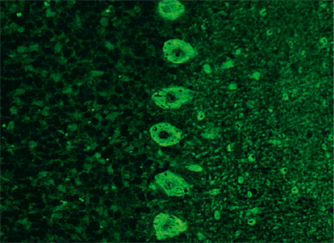
Diagnostics
New diagnostic criteria for PNS have recently been established (Graus et al., 2020). What is new is the subdivision into high-risk phenotypes (encephalomyelitis, limbic encephalitis, rapidly progressive cerebellar syndrome, opsoclonus myoclonus syndrome, sensory neuronopathy, gastrointestinal pseudoobstruction (enteric neuropathy), Lambert–Eaton myasthenic syndrome) and intermediate-risk phenotypes for PNS (including encephalitis, anti-NMDA receptor encephalitis, brainstem encephalitis, Morvan syndrome, isolated myelopathy, stiff-person syndrome, polyradiculoneuropathy).
The term “onconeural antibodies” has been replaced by “high-risk antibodies” for cancer (tumour in >70 % of patients with these antibodies) and “intermediate-risk antibodies” for cancer (tumour in 30 – 70 % of patients with these antibodies). The guidelines classify three levels of evidence for PNS: “definite”, “probable” and “possible”. Each level can be identified using the PNS-care score, which assesses the clinical phenotype, the antibody type, the presence or absence of cancer and the follow-up time. With the exception of opsoclonus myoclonus syndrome, the diagnosis of “definite PNS” requires the presence of high- or intermediate-risk antibodies.
Neuronal antibodies have been established as useful biomarkers and their detection is of paramount importance in the diagnosis of PNS. For a reliable diagnosis, the guidelines recommend that autoantibodies in PNS should always be determined using two independent methods.
Gold standard methods include indirect immunofluorescence (IFA or immunohistochemistry) based on brain sections, for example, using specific BIOCHIP Mosaics from EUROIMMUN for neurology. For confirmation, immunoblots (e. g. EUROLINE profiles) for the monospecific detection of autoantibodies, mainly against intracellular antigens, or cell-based assays (CBAs) for the detection of antibodies against cell surface or synaptic proteins are used. Neuronal autoantibodies should be tested in both serum and cerebrospinal fluid.
| Technology | Parameter | Substrate | Species | Calibration | Ig Class | Format | Order No. |
|---|---|---|---|---|---|---|---|
| EUROLINE | EUROLINE Anti-SOX1, -Titin (IgG) | EUROLINE | IgG |
16 x 01 |
DL 1111-1601-6 G | ||
| IIFT |
brain: grey and white matter, Purkinje cell cytoplasm (Yo), Hu and Ri antigen CV2, Ma, amphiphysin |
cerebellum | monkey | IgAGM IgAGM |
10 x 05 10 x 10 10 x 05 10 x 10 |
FA 1111-1005 FA 1111-1010 FB 1111-1005 FB 1111-1010 |
|
| IIFT |
Neurology Mosaic 1 Yo, Hu, Ri, CV2, Ma, amphiphysin medullated nerves non-medullated nerves |
3 BIOCHIPs per field: cerebellum nerves intestinal tissue |
monkey monkey monkey |
IgAGM IgAGM |
10 x 05 10 x 10 10 x 05 10 x 10 |
FA 1111-1005-1 FA 1111-1010-1 FB 1111-1005-1 FB 1111-1010-1 |
|
| IIFT |
Neurology Mosaic14 cerebellum antigens non-medullated nerves |
2 BIOCHIPs per field: cerebellum intestinal tissue |
monkey monkey |
IgAGM IgAGM |
10 x 05 10 x 10 |
FA 1111-1005-14 FA 1111-1010-14 |
|
| IIFT |
Yo, Hu, Ri, CV2, Ma, amphiphysin medullated nerves non-medullated nerves cell nuclei (ANA) |
cerebellum nerves intestinal tissue HEp-2 cells (4 BIOCHIPs per field) |
monkey monkey monkey human |
IgAGM IgAGM |
10 x 05 10 x 10 10 x 05 10 x 10 |
FA 1111-1005-16 FA 1111-1010-16 FB 1111-1005-16 FB 1111-1010-16 |
|
| IIFT |
Neurology Mosaic 17 Yo, Hu, Ri, CV2, Ma, amphiphysin, NMO cerebrum antigens, NMO NMO, optic nerve antigens aquaporin-4 |
5 BIOCHIPs per field cerebellum cerebrum optic nerve transfected cells control transfection |
monkey monkey monkey EU 90 EU 90 |
IgG IgG IgG |
10 x 05 10 x 10 20 x 05 10 x 05 10 x 10 20 x 05 |
FA 1111-1005-17 FA 1111-1010-17 FA 1111-2005-17 FB 1111-1005-17 FB 1111-1010-17 FB 1111-2005-17 |
|
| IIFT |
Neurology Mosaic 2 Yo, Hu, Ri, CV2, Ma, amphiphysin medullated nerves |
2 BIOCHIPs per field: cerebellum nerves |
monkey monkey |
IgAGM IgAGM |
10 x 05 10 x 10 |
FA 1111-1005-2 FA 1111-1010-2 |
|
| IIFT |
Neurology Mosaic 8 Yo, Hu, Ri, CV2, Ma, amphiphysin medullated nerves non-medullated nerves pancreas islets |
4 BIOCHIPs per field cerebellum nerves intestinal tissue pancreas |
monkey monkey monkey monkey |
IgAGM IgAGM |
10 x 05 10 x 10 10 x 05 10 x 10 |
FA 1111-1005-8 FA 1111-1010-8 FB 1111-1005-8 FB 1111-1010-8 |
|
| IIFT |
Neurology Mosaic14 cerebellum antigens non-medullated nerves |
2 BIOCHIPs per field: cerebellum non-medullated nerves |
monkey monkey |
10 x 05 10 x 10 |
FB 1111-1005-14 FB 1111-1010-14 |
||
| IIFT |
Neurology Mosaic 1 EUROPattern Yo, Hu, Ri, CV2, Ma, amphiphysin medullated nerves non-medullated nerves |
3 BIOCHIPs per field: cerebellum nerves intestinal tissue |
monkey monkey monkey |
IgG IgG |
10 x 05 10 x 10 |
FC 1111-1005-1 FC 1111-1010-1 |
|
| IIFT |
Neurology Mosaic 8 EUROPattern Yo, Hu, Ri, CV2, Ma, amphiphysin medullated nerves non-medullated nerves pancreas islets |
4 BIOCHIPs per field: cerebellum nerves intestinal tissue pancreas |
monkey monkey monkey monkey |
IgG IgG |
10 x 05 10 x 10 |
FC 1111-1005-8 FC 1111-1010-8 |
|
| IIFT |
Neurology Mosaic 14 EUROPattern cerebellum antigens medullated nerves |
2 BIOCHIPs per field cerebellum intestinal tissue |
monkey monkey |
IgG IgG |
120 x 10 20 x 10 |
FC 1111-12010-14 FC 1111-2010-14 |
|
| EUROLINE |
EUROLINE Paraneoplastic Neurologic Syndromes 12 Ag (IgG) (amphiphysin, CV2, PNMA2 (Ma-2/Ta), Ri, Yo, Hu, recoverin, SOX1, titin, Zic4, GAD65, Tr (DNER) separately) |
EUROLINE | IgG IgG IgG |
16 x 01 50 x 01 64 x 01 |
DL 1111-1601-7 G DL 1111-5001-7 G DL 1111-6401-7 G |
||
| IIFT |
antibodies against neuronal nuclei: Hu antigen (Hu ab control) |
IgG |
05 x 02 |
CA 1116-0502 | |||
| EUROLINE |
positive control serum: IgG, human, 100x concentrated for DL 1111-1 G, DL 1111-2 G, DL 1111-4 G and DL 1111-7 G |
IgG |
05 x 07 |
CL 1111-0507 G | |||
| EUROLINE |
positive control serum: IgG, human, 100x concentrated for DL 1111-6 G |
IgG |
05 x 07 |
CL 1111-0507-6 G | |||
| EUROLINE |
EUROLINE Neuronal Antigens Profile 2 (IgG) (amphiphysin, CV2, PNMA2 (Ma-2/Ta), Ri, Yo, Hu separately) |
EUROLINE | IgG |
16 x 01 |
DL 1111-1601-2 G | ||
| EUROLINE |
EUROLINE Neuronal Antigens Profile PLUS RST (IgG) (amphiphysin, CV2, PNMA2 (Ma-2/Ta), Ri, Yo, Hu, recoverin, SOX1, titin separately) |
EUROLINE | IgG |
16 x 01 |
DL 1111-1601-4 G | ||
|
* For research use only, not for in vitro diagnostic use in the sense of EU directive 98/79/EC. 1 Product manufactured by third party. Please contact your local Euroimmun representative for more information. | |||||||